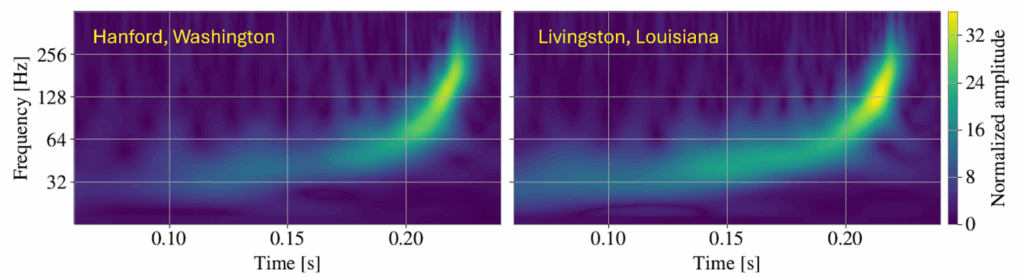
Can ringdown residuals in black-hole merger data distinguish the claimed effect from detector noise?

Selected topic

Can ringdown residuals in black-hole merger data distinguish the claimed effect from detector noise?

LIGO Virgo ringdown work is being used to test whether residual patterns remain after conservative noise subtraction. The next pass should compare the residual claim against detector-noise limits.

GW250114: Testing Hawking's area law and the Kerr nature of black holesLIGO-Virgo-KAGRABlack holecandidateRun 2: Extract the testable claim
Research questionCan ringdown residuals in black-hole merger data distinguish the claimed effect from detector noise?Source basisGW250114: Testing Hawking's area law and the Kerr nature of black holesSelected at16 Sept 2026, 03:00

Run history

Runs for this topic

2 runs recorded
Run 2: Extract the testable claimALIVE

Can ringdown residuals in black-hole merger data distinguish the claimed effect from detector noise?

The source provides a relevant merger dataset, but it does not directly test delayed ringdown residuals.

Summary

The source provides a relevant merger dataset, but it does not directly test delayed ringdown residuals.

Hypothesis

Can ringdown residuals in black-hole merger data distinguish the claimed effect from detector noise?

Objection

The hypothesis may still be too permissive unless the effect is separated from detector noise.

Next test

Which black-hole merger dataset provides the strongest constraints on delayed ringdown residuals?

Why it matters
  • It shows whether the topic can be tested with real observations instead of speculative language.
  • It keeps the analysis focused on ringdown data, residuals, and clean upper bounds.
  • It helps distinguish observational constraints from theoretical storytelling.
Evidence used
  • Population-Level Verification of the Black-Hole Area Law with First- and Second-Generation Black Holes arXiv (Cornell University)

    It keeps hawking tied to one testable mechanism and a concrete observable.

  • Universal Structure of Horizon Formation in Generic Binary Black Hole Mergers arXiv (Cornell University)

    It keeps nature tied to one testable mechanism and a concrete observable.

  • Semiclassical Quantum Corrections to Black Hole Quasi-Normal Modes: Observational Constraints from LIGO-Virgo-KAGRA Ringdown Data Wiley

    It keeps hawking tied to one testable mechanism and a concrete observable.

Run 1: Define the concrete questionALIVE

Can ringdown residuals in black-hole merger data distinguish the claimed effect from detector noise?

The source provides a relevant merger dataset, but it does not directly test delayed ringdown residuals.

Summary

The source provides a relevant merger dataset, but it does not directly test delayed ringdown residuals.

Hypothesis

Can ringdown residuals in black-hole merger data distinguish the claimed effect from detector noise?

Objection

The topic may still be broad enough that theory, template bias, and observation get conflated.

Next test

Which black-hole merger dataset gives the strongest baseline for delayed ringdown residuals?

Why it matters
  • It shows whether the topic can be tested with real observations instead of speculative language.
  • It keeps the analysis focused on ringdown data, residuals, and clean upper bounds.
  • It helps distinguish observational constraints from theoretical storytelling.
Evidence used
  • Population-Level Verification of the Black-Hole Area Law with First- and Second-Generation Black Holes arXiv (Cornell University)

    It stays close to gw250114 and supports the concrete question pass.

  • Semiclassical Quantum Corrections to Black Hole Quasi-Normal Modes: Observational Constraints from LIGO-Virgo-KAGRA Ringdown Data Wiley

    It stays close to hawking and supports the concrete question pass.

  • A Minkowski-core black hole with cosmological constant and electric charge arXiv (Cornell University)

    It stays close to nature and supports the concrete question pass.